Motion Simulation: Six-Degree-of-Freedom Motion Platform
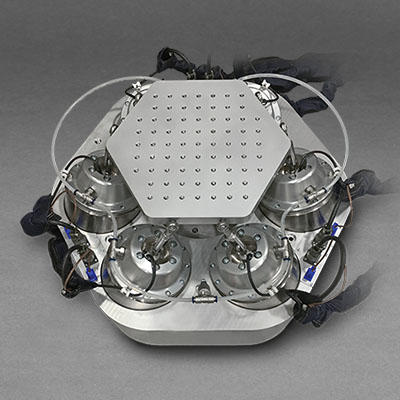
HEXAPODS–Vibration and Motion Control Platform
A hexapod robot is a robotic manipulator capable of moving a payload in all six degrees of freedom: lateral, longitudinal, vertical translation, and roll, pitch, and yaw rotation. It can move simultaneously along multiple axes or independently along a single axis while preventing movement along the other axes. Compared to other robotic manipulator architectures, the hexapod's parallel actuator arrangement provides high load capacity, stiffness, and precision.
The applications of hexapod positioning stages are generally divided into three main categories: precise positioning, motion simulation, and vibration isolation. The differences between product models lie in their drive, sensing, control systems, payload capacity, range, resolution, and bandwidth.
Hexapod systems are needed for various purposes. They can allow payloads (such as optical or laser sources) to be precisely aligned and oriented relative to another object, and even when thermal or other forms of drift continuously cause misalignment, they can simulate road conditions of vehicle suspension systems, thereby eliminating expensive field testing. Hexapod positioning stages can also isolate payloads (including cameras or sensitive measurement instruments) from ground vibrations or aircraft jitter, which would otherwise cause image blur, measurement errors, or potential damage. Other motion control devices generally only provide one or two degrees of freedom for positioning, motion simulation, or vibration isolation, but when multi-degree-of-freedom motion is required, hexapod positioning stages are the ideal solution.
Application areas (motion simulation)
Flight simulator
Missile tracker simulation
Automobile suspension system testing
Simultaneous multi-axis vibration testing
Interference sources
Cinema amusement facilities
➤ Actuators, sensors, and end-effectors optimized for applications
➤ Customizable pillar geometry and mechanical interfaces for each application
➤ Real-time controller with a 2kHz sampling rate
➤ Web browser graphical user interface
➤ Standard libraries for multi-axis control
➤ Real-time kinematics computation
➤ XML-RPC communication between host and target for easy system integration
➤ Real-time data logging
➤ Options for automatic operation and accepting remote commands
➤ Fully passive devices available for vibration isolation
➤ Vacuum compatibility options for most hexapod models
Standard and Custom Systems
Most standard hexapod cabins are used for small payloads, but the systems we offer range in size from 130mm to 3m, with load capacities between 0.5 and 15,000kg. We also build octopod cabins and systems with reduced degrees of freedom for specific applications.